
Selection Guides
How to select a valve positioner: linear vs rotary, smart vs electro-pneumatic
A decision guide to specifying a valve positioner: actuator motion, single or double acting, feedback options, area classification and when smart pays.
- Written by
- A.N Trader technical team
- Published
- Reading time
- 7 min read
A positioner does one job: it holds the valve at the position the 4-20 mA command asks for, by comparing that demand against mechanical feedback taken from the stem or shaft and adding or exhausting air until the two agree. Every positioner on this page does that. The specification questions that actually decide which one you order are narrower, and they come in a fixed order: what the actuator moves like, how it is piped, what the atmosphere around it is, and whether you will ever ask the device a question.
This guide works through those in sequence, using the published figures for the Rotork YTC YT-1000, YT-1050 and YT-3300 families. The same logic applies to any manufacturer’s range.
Step 1 — Motion type decides the model, not the option
Linear and rotary are not a configuration flag. They change the feedback mechanism, so they change the part number and the lever you order with it.
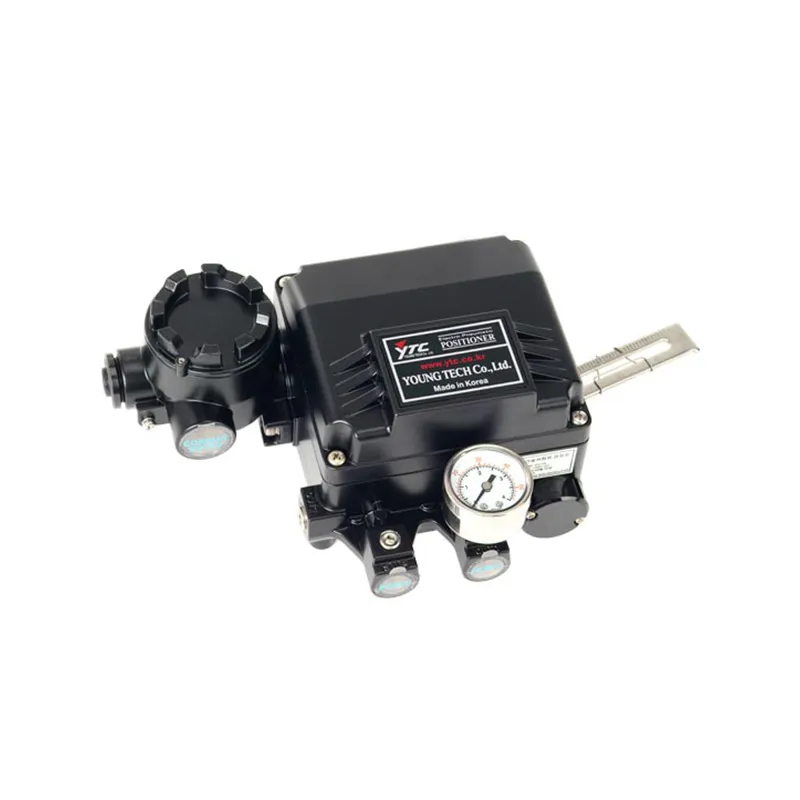
A linear positioner reads travel through a lever and stroke pin that follow the valve stem, and the lever is a selected part. On the YT-1000L the four bands are 10~40, 30~70, 60~100 and 100~150 mm, covering the family’s 10 to 150 mm stroke range. Order a lever sized for the wrong travel and you lose resolution across the whole stroke — the commonest specification error we see, and one that no amount of tuning afterwards will recover.
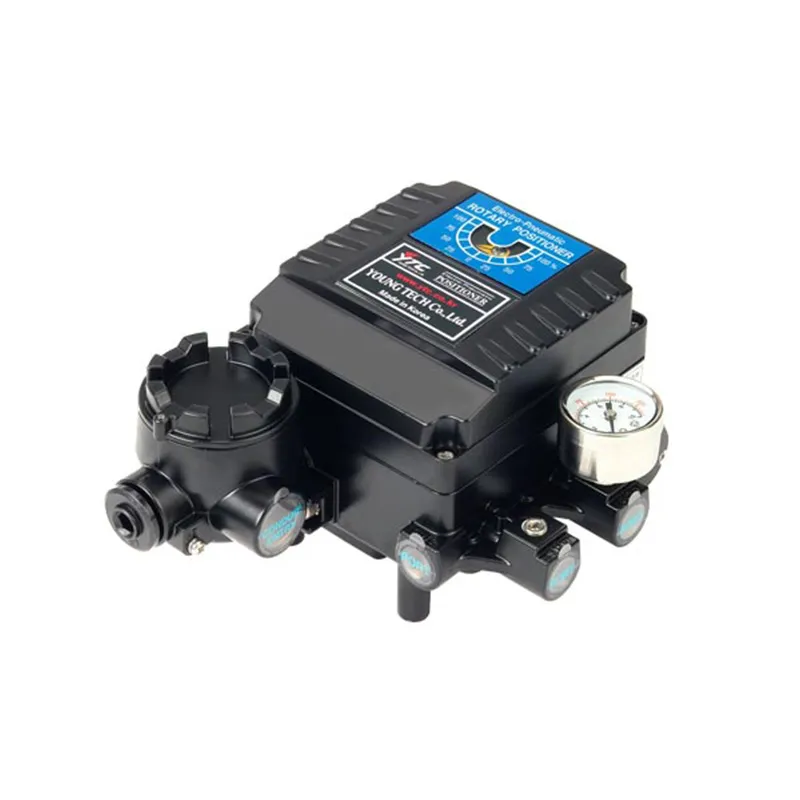
A rotary positioner reads a 0 to 90° arc off a shaft. Its equivalent part is a threaded arm — M6 × 34L, M6 × 63L, M8 × 34L, M8 × 63L — or a NAMUR coupling. Fit the YT-1000R to butterfly, ball and plug valves.
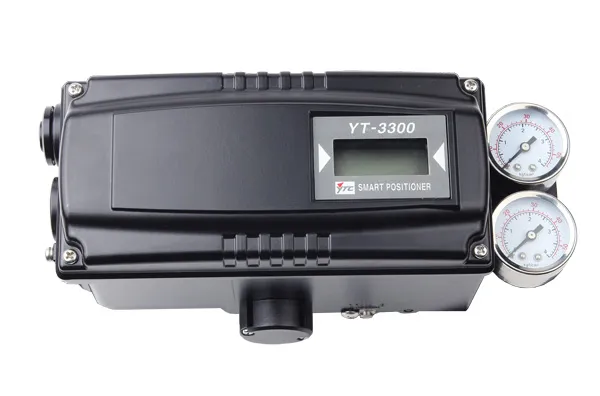
The YT-3300 smart family covers the same envelope — 10 to 150 mm linear or 0 to 90° rotary — but its linear levers are listed as two different mechanisms rather than four bands: fork type (10~40, 20~100, 90~150 mm) and roller type (16~30, 16~60, 16~100, 90~150 mm). The datasheet also notes that the YT-3303 and YT-3301 take the YT-3400 lever rather than the YT-3300’s. Take the lever code from the model-code sheet for the exact model you are ordering; they are not interchangeable between families.
Step 2 — Single or double acting
Single-acting drives one side of a spring-return actuator and lets the spring do the return. Double-acting drives both chambers of a spring-less actuator. Both YTC families offer the choice as a letter in the model code (S or D), so this does not change the model — but on the analogue family it does change the published performance:
| Figure | YT-1000 / YT-1050 single acting | YT-1000 / YT-1050 double acting |
|---|---|---|
| Linearity | ±1% F.S. | ±2% F.S. |
| Sensitivity | ±0.2% F.S. | ±0.5% F.S. |
| Hysteresis | ±1% F.S. | ±1% F.S. |
| Repeatability | ±0.5% F.S. | ±0.5% F.S. |
If a loop needs tighter than 1% linearity on a double-acting actuator, the analogue positioner is not the answer — the YT-3300 family holds ±0.5% F.S. linearity and hysteresis regardless of acting type.
Step 3 — Analogue or smart
This is where the money is, so it is worth being specific about what the extra buys. Both families take the same 4-20 mA DC input and the same 0.14 to 0.7 MPa (1.4 to 7 bar) supply.
| Specification | YT-1000 / YT-1050 | YT-3300 family |
|---|---|---|
| Input impedance | 250 ± 15 Ω | Max. 500 Ω @ 20 mA DC |
| Linearity | ±1% F.S. single / ±2% double | ±0.5% F.S. |
| Hysteresis | ±1% F.S. | ±0.5% F.S. |
| Repeatability | ±0.5% F.S. | ±0.3% F.S. |
| Air consumption | 2.5 LPM (sup. 0.14 MPa) | Below 2 LPM (sup. 0.14 MPa, idle) |
| Flow capacity | 80 LPM (sup. 0.14 MPa) | 70 LPM (sup. 0.14 MPa) |
| Operating temperature | -20 to 70 °C; -20 to 60 °C explosion protected | -30 to 85 °C; -40 to 85 °C low-temp build |
| Ingress protection | IP66 | IP66, Type 4X (FM) |
| Communication | None | HART rev. 7 (option) |
| Characterisation | None | Linear, EQ%, Quick Open, user set |
| Functional safety | Not stated on the datasheet | SIL 2, and SIL 3 in a redundant structure |
| Vibration | No resonance 5 to 200 Hz | No resonance up to 100 Hz @ 6G |
Two rows deserve comment. The flow capacity is lower on the smart family — 70 LPM against 80 LPM — so a large actuator that already strokes slowly will not stroke faster because you fitted a smart positioner. And the air consumption is lower, below 2 LPM at idle against 2.5 LPM, which on a plant with several hundred positioners is a real compressor load, not a brochure line.
Step 4 — Feedback, switches and what the control room gets back
An analogue positioner is a one-way device unless you pay for feedback. On the YT-1000L the internal options are a 4 to 20 mA position feedback, with or without an LCD. On the YT-1000R the option list extends to limit switches as well, internal or external — and carries the constraint that catches people out: the datasheet marks the internal 4 to 20 mA feedback and the internal limit switch as available “only for non-explosion area protection”. On a certified YT-1000R those have to be ordered as external units.
The YT-3300 family sets this out as an output-option digit: none, 4 to 20 mA feedback, mechanical limit switch, proximity limit switch, or feedback combined with either switch. Limit switches are only offered on the YT-3300 and YT-3350 — the YT-3303 and YT-3301 stop at the position transmitter. Switch ratings are AC 125 V, 3 A / DC 30 V, 2 A mechanical (Omron) and DC 8.2 V, 8.2 mA proximity (P+F).
Step 5 — Area classification narrows the field faster than anything else
This is the step that most often overrides everything above, and the two families differ fundamentally.
The YT-1000 / YT-1050 datasheet lists flameproof and encapsulated protection alongside intrinsic safety: Ex dmb IIB T5, Ex d IIC T5 IP66, Ex ia IIB T6 Gb, plus FM XP-S/I/1/CD/T5 and DIP/II,III/1/EFG/T5 at Ta=60 °C, Type 4X, and regional NEPSI and TIIS approvals.
The YT-3300 family is certified as an intrinsically safe device: Ex ia IIC T5/T6 Gb and Ex iaD IIIC T100 °C/T85 °C Db to IP66 under ATEX, IECEx, KCs and NEPSI, with FM and CSA equivalents.
If your site’s electrical philosophy is flameproof enclosures and glands rather than barriers, the analogue family carries the certification for it and the smart family does not. That single fact settles a good number of specifications before performance is discussed at all.
Step 6 — Body material
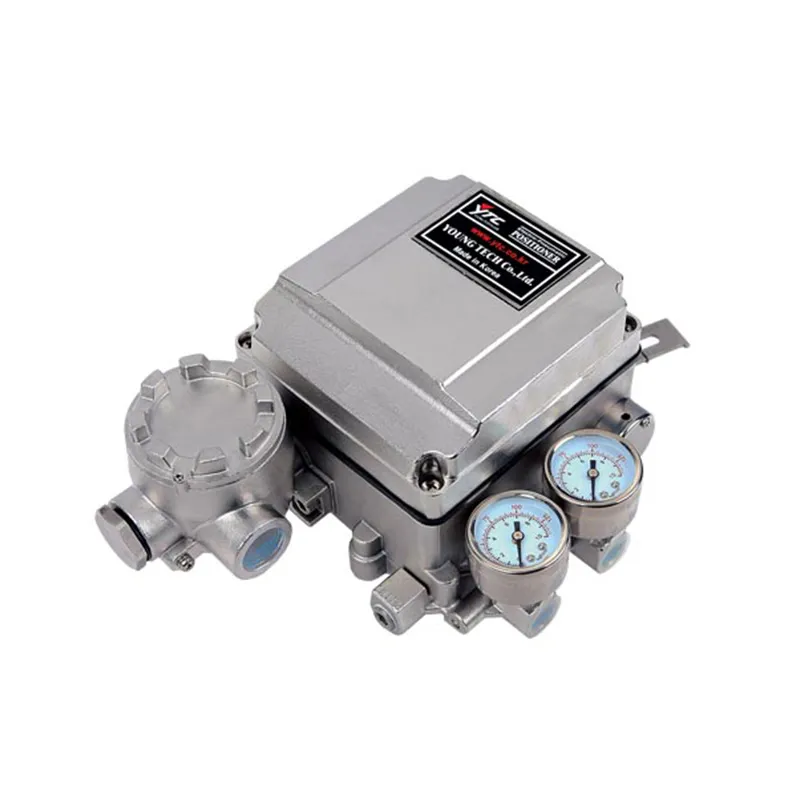
Aluminium die-casting is the default and it is the lighter one: the YT-1000L is 2.7 kg, the YT-1000R 2.8 kg, the YT-3300 2 kg. Stainless steel 316 costs weight — the YT-1050 is 5.71 kg and the YT-3350 is 5.1 kg — and on a small actuator you should check the bracket and yoke are rated to carry it. Specify stainless for coastal, washdown or chemically aggressive service, not as a general upgrade.
When the diagnostics justify the cost
A smart positioner earns its price in four situations, and no others worth paying for:
- The valve is in a safety function. The YT-3300 family is certified
SIL 2, and up toSIL 3in a redundant structure, with the safety function defined as moving to fail-safe position when the signal is interrupted. Its adjustable partial stroke test can be run locally from the pushbuttons or remotely overHART, and it stores the last three results — that is a testable ESD valve without a shutdown. - The valve characteristic is wrong and you cannot change the trim. Linear, equal-percentage, quick-open and a user-set curve are configuration, not hardware.
- You need position back without running a second cable.
HARTrev. 7 carries position and diagnostics over the existing current loop. - Calibration access is bad. Auto-calibration and front-panel PID tuning remove most reasons to go back to the valve twice.
If none of those apply — a modulating service on a spring-and-diaphragm actuator, maintained by the site’s own instrument technicians, in a flameproof area, at 1% linearity — the analogue positioner is the correct engineering answer, not the cheap one. Its zero and span are dials with locking screws, direct and reverse action is a switch, and there is no menu to relearn.
How to decide, in order
- Linear or rotary? Pick the model, then pick the lever band from the actual valve travel.
- Spring-return or double-acting? Set the acting code, and check the linearity you are accepting.
- Area classification and protection concept — intrinsically safe or flameproof. This may end the exercise.
- Corrosive atmosphere? Move to the stainless body and check the bracket loading.
- Does anything need to come back to the control room — position, limits, diagnostics, a partial stroke test?
- Only now, analogue or smart.
Whatever you land on, feed it through a dedicated filter regulator: the YT-3300 manual requires clean, dry air compliant with ISO 8573-1 or ISA 7.0.01, filtered to 5 micron or smaller, with the regulator set 10% above the actuator’s spring range.
Products mentioned
Related guides
-
Selection Guides
Specifying a dust collector pulse valve: the ASCO Series 353
Sizing and specifying ASCO Series 353 pulse valves for pulse-jet baghouses: orifice and Kv by size, diaphragm choice, pilot options and spare kits.
-
Comparisons
I/P converters explained: selecting between the YT-930 and YT-940
What an I/P converter does, how the Rotork YTC YT-930 and YT-940 differ on protection concept and supply banding, and why converters fail in service.
-
Standards & Certification
Reading a Rosemount 3051 model code: ranges, output, SIL and manifolds
Decode a Rosemount 3051 model string field by field: measurement type, range codes, HART vs Fieldbus, housing, SIL 2/3 to IEC 61508 and manifolds.