
Comparisons
YT-3300 vs YT-3301 vs YT-3303 vs YT-3350: choosing a Rotork YTC smart positioner
Four Rotork YTC smart positioners on one electronics platform. Housing, mounting side, remote sensor, orifice, switches and certificates compared.
- Written by
- A.N Trader technical team
- Published
- Reading time
- 7 min read
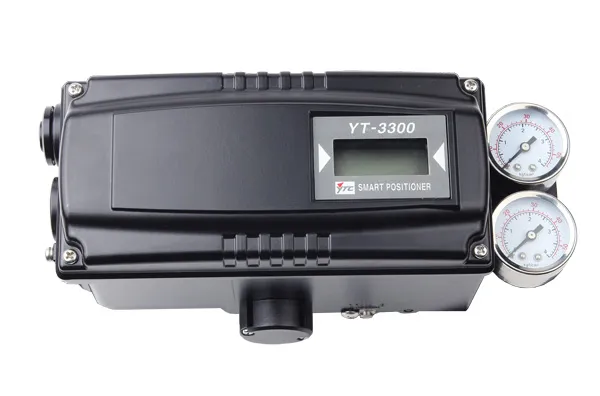
Four model numbers, one set of electronics. That is the single most useful thing to know before specifying anything in the Rotork YTC YT-3300 family: the torque motor, the microprocessor, the LCD, the four pushbuttons, the auto-calibration, the PID block and the partial stroke test are common to all four. Nothing in the signal path changes between a YT-3300 and a YT-3350.
What changes is the box they are in, where that box bolts on, and what you can bolt onto it. This article sets the shared platform out once, then puts the four models side by side on the specifications that actually differ, and finishes with the order in which to make the decision.
The shared platform
Every figure below is identical across the YT-3300, YT-3301, YT-3303 and YT-3350.
| Item | Value |
|---|---|
| Input signal | 4~20 mA DC |
| Minimum current signal | 3.2 mA standard; 3.8 mA with HART |
| Impedance | Max. 500 Ω @ 20 mA DC |
| Supply pressure | 0.14 ~ 0.7 MPa (1.4 ~ 7 bar) |
| Stroke | 10 ~ 150 mm linear; 0 ~ 90° rotary |
| Acting type | Single or double — a model-code letter, not a different model |
| Linearity / hysteresis | ±0.5% F.S. / ±0.5% F.S. |
| Sensitivity / repeatability | ±0.2% F.S. / ±0.3% F.S. |
| Flow capacity | 70 LPM (sup. 0.14 MPa) |
| Air consumption | Below 2 LPM (sup. 0.14 MPa, idle) |
| Ingress protection | IP66, Type 4X (FM) |
| Operating temperature | -30 to 85 °C standard; -40 to 85 °C low-temperature build |
| Explosion-proof ambient | -40 to 60 °C (T5); -40 to 40 °C (T6) |
| Humidity | 5 ~ 95% RH @ 40 °C |
| Vibration | No resonance up to 100 Hz @ 6G |
| Communication | HART rev. 7 (option) |
| Feedback signal | 4~20 mA (DC 9~28 V) (option) |
| Output characteristic | Linear, EQ%, Quick Open, user set |
| Functional safety | SIL 2; SIL 3 in a redundant structure |
Note on the characterisation curve: the datasheet and the product manual give different point counts for the user-set curve, so we quote neither. Confirm the number against the firmware revision you are supplied.
Where the four models differ
| Specification | YT-3300 | YT-3303 | YT-3350 | YT-3301 / 3302 |
|---|---|---|---|---|
| Housing material | Aluminium die-casting | Aluminium die-casting | Stainless steel 316 | Aluminium die-casting |
| Painting | Epoxy polyester powder coating | Epoxy polyester powder coating | None | Epoxy polyester powder coating |
| Weight | 2 kg (4.4 lb) | 2 kg (4.4 lb) | 5.1 kg (11.2 lb) | Body 2.2 kg; sensor 0.6 kg linear / 1.0 kg rotary; 0.6 kg per 5 m of cable |
| Feedback sensor | Integral | Integral | Integral | Remote, on 5 / 10 / 15 / 20 m of cable |
| Sensor temperature | — | — | — | -40 to 120 °C (-40 to 248 °F) |
| Linear mounting side | Right-hand yoke | Left-hand yoke | Right-hand yoke | Remote |
| Orifice | Plate type | Field-adjustable variable orifice | Plate type | Plate type |
| Air connection | PT (NPT, G) 1/4 | PT (NPT, G) 1/4 | NPT 1/4 | PT (NPT, G) 1/4 |
| Gauge connection | PT (NPT) 1/8 | PT (NPT) 1/8 | NPT 1/8 | PT (NPT) 1/8 |
| Conduit entry | G(PF) 1/2, NPT 1/2 or M20 × 1.5P | G(PF) 1/2, NPT 1/2 or M20 × 1.5P | G(PF) 1/2 only | G(PF) 1/2, NPT 1/2 or M20 × 1.5P |
| Limit switch option | Mechanical or proximity | Not offered | Mechanical or proximity | Not offered |
One weight to treat with care: the YT-3301 figures above are the manual’s, broken into body, sensor and cable. The datasheet summarises the same model as a 2 kg body with a 0.9 kg sensor. Use the manual’s breakdown for bracket loading.
Three of those rows decide most orders.
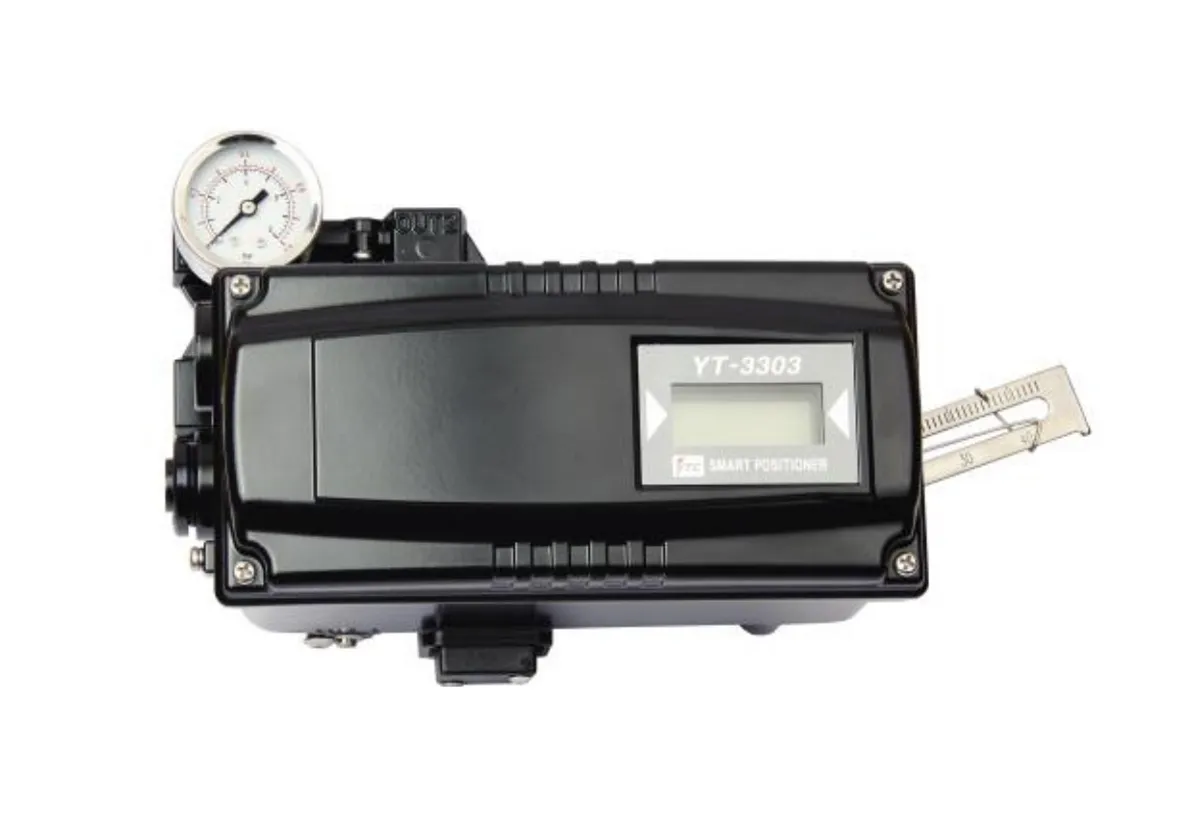
Mounting side. On a sliding-stem valve the YT-3300 goes on the right-hand yoke and the YT-3303 on the left. That is not a preference; it is whether the positioner physically fits once the handwheel, stem connector, tubing and the next pipe along are in place. On retrofits and tightly packed skids this is the deciding specification, and it is settled by looking at the actuator, not at a datasheet. The manual is the authority here — the model-code block on the datasheet describes the YT-3303 lever the other way round, and where the two disagree we follow the manual.
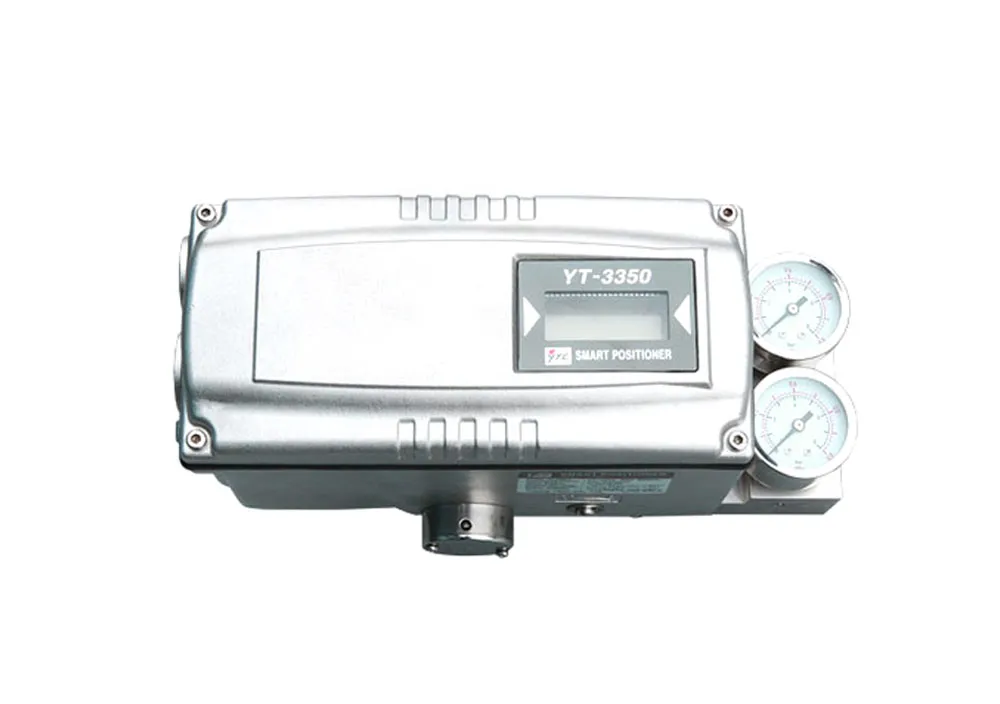
Conduit and air connections. The YT-3350 offers one combination, G(PF) 1/2 conduit with NPT 1/4 air, where the aluminium bodies offer three conduit entries. If your site standard is M20 × 1.5 glands, the stainless model will need an adapter. Check this before you order, not on site.
Limit switches. Only the YT-3300 and YT-3350 take them, as a mechanical (Omron, AC 125 V, 3 A / DC 30 V, 2 A) or proximity (P+F, DC 8.2 V, 8.2 mA) type, alone or combined with the 4~20 mA position transmitter. If the valve needs discrete open and closed contacts back to a PLC, the YT-3303 and YT-3301 are out of the running whatever else recommends them.
The two special-purpose models
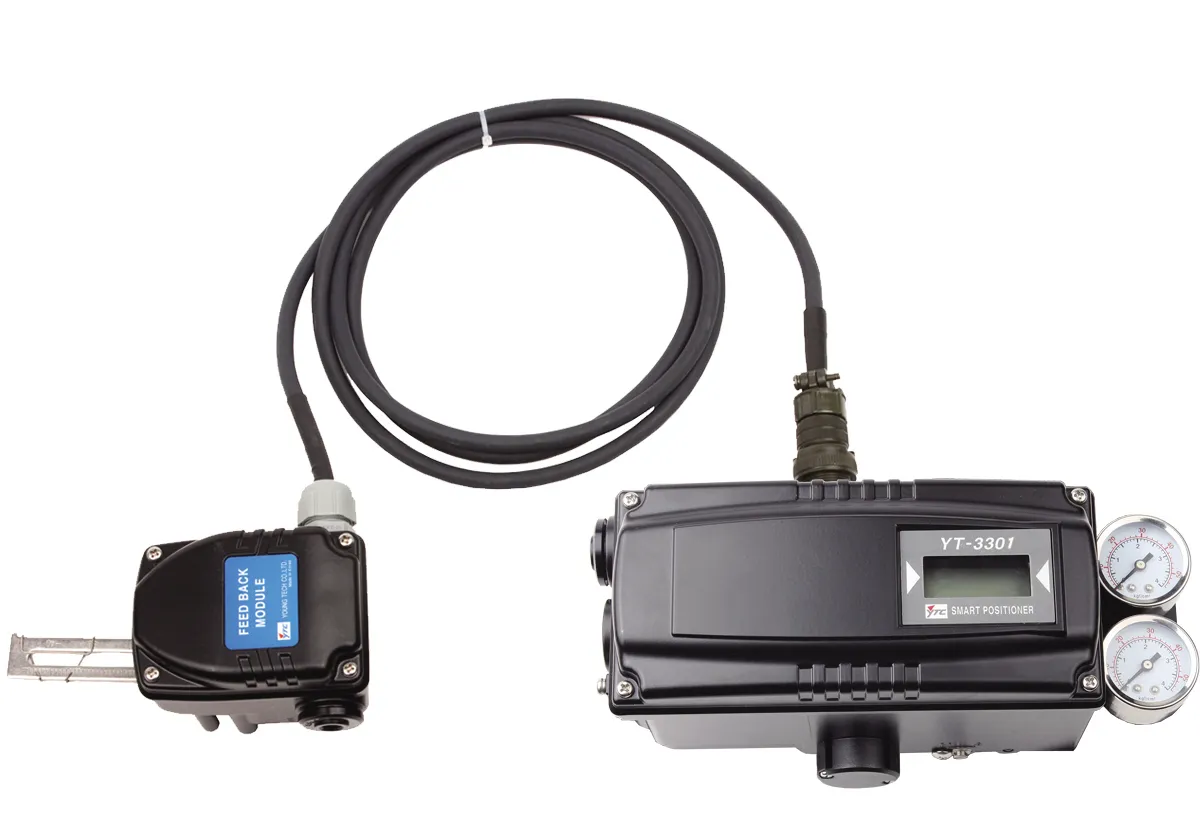
The YT-3301 exists to solve heat and vibration. Its feedback sensor separates from the positioner body on a cable of up to 20 m, and the sensor is rated -40 to 120 °C — far past the -30 to 85 °C the electronics will take. A valve on a hot line, or on a machine that shakes hard enough to worry an LCD, can be instrumented properly by putting the fragile half somewhere survivable. On the YT-3302: the manual lists it on the same specification table as the YT-3301 and refers to shared remote-sensor components, but sets out no separate ordering code, so we publish no claimed difference.
The YT-3303 exists to solve fit, and brings one pneumatic advantage with it: a variable orifice adjusted in the field with a flat screwdriver, where the rest of the family uses plate-type orifices. Turn the slot toward vertical for maximum flow, horizontal for minimum. A technician can damp hunting on a small, fast actuator, or open the flow up on a sluggish one, without removing the positioner or fitting a different plate. If you are chasing an oscillation on a small actuator, that alone can be worth the model change — the manual’s own warning code for a full stroke completing in under one second tells you to fit an orifice and reduce flow.
Certification, by number
All four models are certified as intrinsically safe devices, rated Ex ia IIC T5/T6 Gb with Ex iaD IIIC T100 °C/T85 °C Db. The certificates named in the manual are:
| Scheme | Certificate number |
|---|---|
| ATEX | EPS 12 ATEX 1 456 X |
| IECEx | IECEx EPS 12.0017X |
| NEPSI | GYJ11.1599X |
| FM | FM16US0268X |
| CSA | CSA 17.70131426 |
| TR CU (EAC) | RU C-KR.MЮ62.B.04756 |
| SIL 2 | V 460.02/15 |
KCs certification is issued per model and per switch type, which makes it the quickest way to confirm you are looking at the right variant:
| Model | KCs certificate |
|---|---|
| YT-3300 | 12-KB2BO-0398X |
| YT-3300 + limit switch, dry contact | 12-KB2BO-0399X |
| YT-3300 + limit switch, non-contact | 14-KB2BO-0333X |
| YT-3303 | 14-KB2BO-0335X |
| YT-3350 | 12-KB2BO-0402X |
| YT-3350 + limit switch, dry contact | 12-KB2BO-0401X |
| YT-3350 + limit switch, non-contact | 14-KB2BO-0334X |
| YT-3301 | 12-KB2BO-0400X |
For barrier selection, the intrinsic-safety entity parameters on the label are Ui = 28 V, Ii = 93 mA, Pi = 651 mW, with Ci = 0.6 nF and Li = 10 μH for ATEX and Ci = 0.55 nF, Li = 12 μH for FM. One caveat worth carrying to your functional-safety assessment: the datasheet marks CSA as “certification in progress” while the manual quotes a CSA certificate number. Ask for the current certificate rather than relying on either document.
How to decide
- Is the atmosphere corrosive, coastal or washdown? If yes, YT-3350 — and check the bracket and yoke will carry
5.1 kgrather than2 kg. It is also the only model in the family with no coating at all, which is deliberate: bare 316 outlasts a coated substrate in exactly those environments. - Is the mounting point too hot, or does it vibrate hard? If yes, YT-3301, and choose the cable length from the actual routing.
- Does the valve need discrete limit contacts? If yes, you are choosing between the YT-3300 and the YT-3350 only.
- Will the positioner physically fit on the right-hand yoke? If not, YT-3303.
- None of the above? YT-3300. It is the baseline, it is among the lightest at
2 kg, and it shares the family’s widest choice of conduit entry with the YT-3303 and YT-3301.
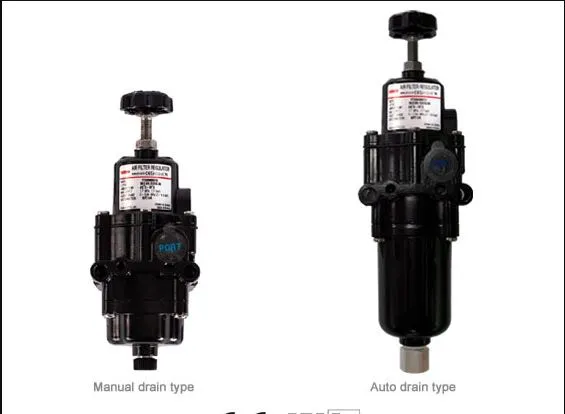
Whichever you land on, the pneumatic requirement is the same: clean, dry air per ISO 8573-1 or ISA 7.0.01, filtered to 5 micron or smaller, with the filter regulator set 10% above the actuator’s spring range.
Products mentioned
Related guides
-
Comparisons
I/P converters explained: selecting between the YT-930 and YT-940
What an I/P converter does, how the Rotork YTC YT-930 and YT-940 differ on protection concept and supply banding, and why converters fail in service.
-
Selection Guides
How to select a valve positioner: linear vs rotary, smart vs electro-pneumatic
A decision guide to specifying a valve positioner: actuator motion, single or double acting, feedback options, area classification and when smart pays.
-
Standards & Certification
Reading a Rosemount 3051 model code: ranges, output, SIL and manifolds
Decode a Rosemount 3051 model string field by field: measurement type, range codes, HART vs Fieldbus, housing, SIL 2/3 to IEC 61508 and manifolds.